

- This project was originally based on Potree Viewer 1.6 and is now since version 2.0 based on the shiukaheng fork of the Potree-Loader.
- Potree is a web based pouint cloud visualizer project created by Markus Schütz.
- This project contains only the main parts of the potree project adapted to be more easily used as a independent library, the code was adapted from the original repositorys.
- Support for pointclouds from LAS, LAZ, Binary files.
- Some features require support for the following GL extensions
- EXT_frag_depth, WEBGL_depth_texture, OES_vertex_array_object
- Live demo at https://tentone.github.io/potree-core/
- Double click the models to raycast the scene and create marker points.
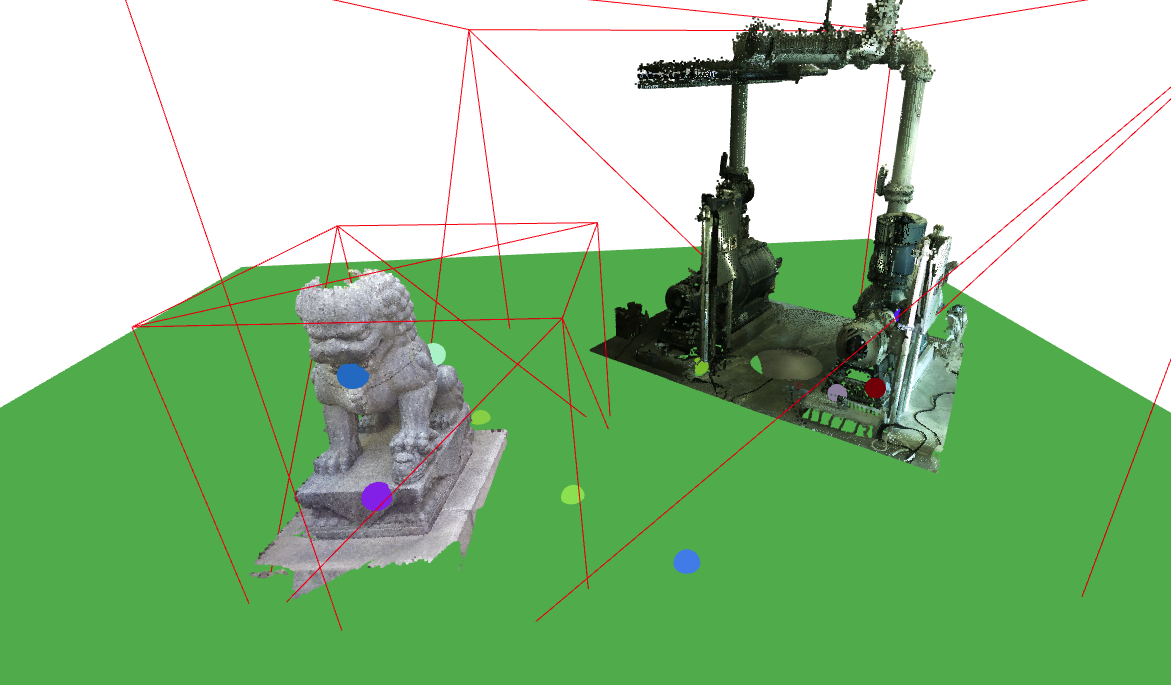
- The project can be build running the commands
npm installandnpm run build. - Download the potree build from the build folder or add it to your project using NPM.
- Include it alonside the worker folder in your project (can be found on the source folder).
- The build is a ES module, that can be imported to other projects, threejs should be available as a peer dependency.
- Bellow its a fully functional example of how to use this wrapper to load potree point clouds to a three.js project
const scene = new Scene();
const camera = new PerspectiveCamera(60, 1, 0.1, 10000);

const canvas = document.getElementById("canvas");

const renderer = new WebGLRenderer({canvas:canvas});

const geometry = new BoxGeometry(1, 1, 1);
const material = new MeshBasicMaterial({color: 0x00ff00});
const cube = new Mesh(geometry, material);
scene.add(cube);

const controls = new OrbitControls(camera, canvas);
camera.position.z = 10;

const pointClouds = [];

const baseUrl = "data/test/";
const potree = new Potree();
potree.loadPointCloud("cloud.js", url => `${baseUrl}${url}`,).then(function(pco) {
   scene.add(pco);
	pointClouds.push(pco);
});

function loop()
{
   potree.updatePointClouds(pointClouds, camera, renderer);

	controls.update();
	renderer.render(scene, camera);

	requestAnimationFrame(loop);
};
loop();- Clip boxes restrict the rendered region of a point cloud to a box-shaped volume.
- Use
createClipBox(size, position, mode?)to build anIClipBox. mode?: "include" | "exclude".include: clip-outside semantics for that volume (inside can stay visible).exclude: clip-inside semantics for that volume (inside is removed).- If
modeisundefined, that volume inherits the global materialclipMode. ClipMode.DISABLEDis a global master off switch and disables all clipping/highlighting.- Clipping uses one unified rule across boxes, spheres, and clip planes:
- include volumes are unioned
- exclude volumes are unioned
B = (!hasIncludeVolumes || insideAnyInclude) && !insideAnyExcludeP = insideAllPlanesS = hasBoxOrSphere- For
CLIP_OUTSIDE:visible = B && P - For
CLIP_INSIDE:visible = (S && B) || !P
- Global
ClipMode.HIGHLIGHT_INSIDEis still supported through inheritance (modeundefined) and only highlights without changing visibility. - Clip planes are evaluated as
insideAllPlanes(point is on the positive side of all planes). - Planes are integrated into the same formulas via
P, so plane-only behavior falls out naturally from the same equations.
import { ClipMode, createClipBox } from 'potree-core';
import { Vector3 } from 'three';

pco.material.clipMode = ClipMode.CLIP_OUTSIDE; // global fallback for undefined volume modes

const includeA = createClipBox(new Vector3(10, 10, 10), new Vector3(0, 0, 0), 'include');
const excludeB = createClipBox(new Vector3(4, 4, 4), new Vector3(0, 0, 0), 'exclude');
const inheritedD = createClipBox(new Vector3(3, 3, 3), new Vector3(-3, 0, 0)); // inherits CLIP_OUTSIDE

pco.material.setClipBoxes([includeA, excludeB, inheritedD]);- Clip spheres work like clip boxes and support the same optional mode.
- Use
createClipSphere(center, radius, mode?)to build anIClipSphere. mode?: "include" | "exclude".- If
modeisundefined, the sphere inherits the global materialclipMode.
- Clip planes do not have per-plane mode; they always use inherited global mode behavior.
- Planes are represented by
P = insideAllPlanesin the visibility formulas above.
import { ClipMode, createClipSphere } from 'potree-core';
import { Vector3 } from 'three';

pco.material.clipMode = ClipMode.HIGHLIGHT_INSIDE;

const sphereA = createClipSphere(new Vector3(0, 1, 0), 3, 'exclude');
const sphereB = createClipSphere(new Vector3(5, 1, 0), 2); // inherits HIGHLIGHT_INSIDE

pco.material.setClipSpheres([sphereA, sphereB]);- The potree core library uses a custom request manager to handle the loading of point cloud data.
- The request manager can be replaced by a custom implementation, for example to use a custom caching system or to handle requests in a different way.
class CustomRequestManager implements RequestManager
{
   fetch(input: RequestInfo | URL, init?: RequestInit): Promise<Response> {
      throw new Error("Method not implemented.")
   }

   async getUrl(url: string): Promise<string> {
      return url;
   }
}- Since potree-core is meant to be used as library and not as a full software as potree some features are not available.
- EDL shading is not supported by potree core.
- Removed Arena 4D point cloud support.
- Removed Entwine Point Tile file support.
- GUI elements were removed from the library
- PotreeViewer
- Controls, Input, GUI, Tools
- Anotations, Actions, ProfileRequest
- Potree.startQuery, Potree.endQuery and Potree.resolveQueries
- Potree.timerQueries
- Potree.MOUSE, Potree.CameraMode
- PotreeRenderer, RepRenderer, Potree.Renderer
- JQuery, TWEEN and Proj4 dependencies
- Use the (Potree Converter)[https://github.com/potree/PotreeConverter/releases] tool to create point cloud data from LAS, ZLAS or BIN point cloud files
- Potree Converter 1.8 creates a multi file structure with each node as an individual file.
- Potree Converter 2.1 creates a single file for all points and separates files for hierarchy index, its faster to create files. Requires a HTTP server configured for file streaming.
- Tool to create hierarquical structure used for point-cloud rendering using potree-core.
- There are two main versions 2.1 witch generates 4 contained files with point data, hierarchy,
- To generate a folder output from a input file run the command
.\PotreeConverter '..\input.laz' -o ../output
- The potree converter tool only supports las and laz files, so textural file formats such as .pts, .xyz, have to be first converted into a supported format.
- The TXT2LAS tool from the (LASTools)[https://github.com/LAStools/LAStools] repository can be used for this effect.
- To run the tool use the command
.\txt2las64 -i input.pts -ipts -parse xyziRGB -set_scale 0.001 0.001 0.001 -set_version 1.4 -o output.laz
- Supports logarithmic depth buffer (just by enabling it on the threejs renderer), useful for large scale visualization.
- Point clouds are automatically updated, frustum culling is used to avoid unnecessary updates (better update performance for multiple point clouds).