


Leakly uses label permutation to test whether a machine-learning pipeline performs above chance when no true signal is present.
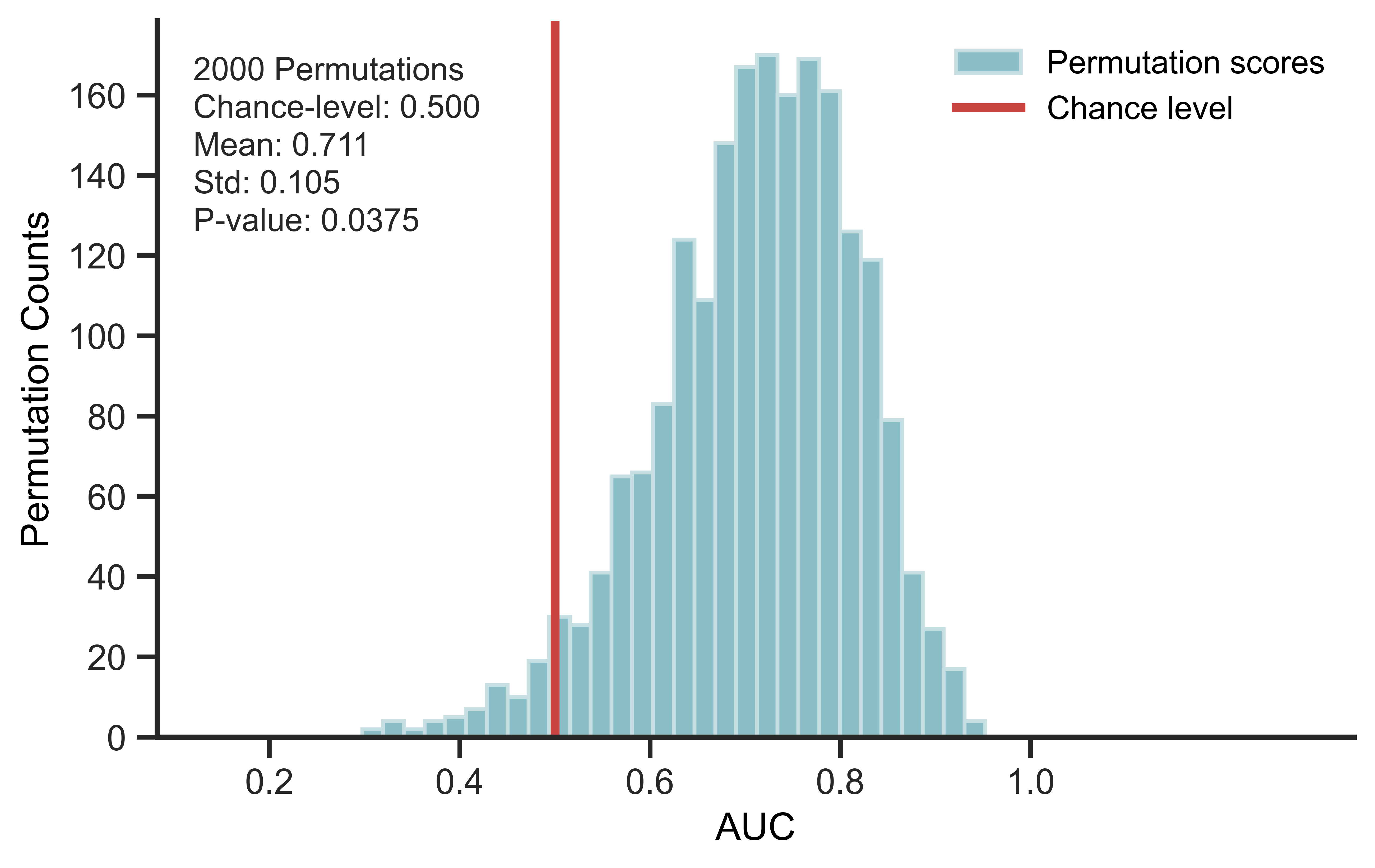
Above-chance performance after permutation may indicate leakage from preprocessing, feature selection, tuning, or another step of the pipeline.
- Permute labels to remove the real feature-label association.
- Run the full pipeline exactly as in the original analysis.
- Compare the permuted score distribution with chance level.
- Above-chance permuted performance suggests possible leakage.
Leakly includes example configurations for a leaky pipeline and a non-leaky pipeline so users can inspect the effect directly.
pip install Leakly
from leakly import (
    MLPipeline,
    SummaryPlotter,
    load_example_leakage_config,
    permute_label)

scores = []
for seed in range(100):
    permuted_y = permute_label(y, random_state=seed)
    score = (
        # Replace with any user-defined pipeline
        MLPipeline(
            X,
            permuted_y,
            covariates=covariates,
            config=load_example_leakage_config(),
        ).fit()
    ).evaluate()
    scores.append(score)

SummaryPlotter(scores, chance_level=0.5).plot()Can Leakly check my own pipeline?
Yes. Leakly can evaluate any pipeline that takes X, y,
optional covariates, and returns a test score.
The key is to run the full pipeline exactly as in the real analysis,
including preprocessing, feature selection, tuning, and evaluation.
Why can a leaky pipeline score well on permuted labels?
If leakage occurs, information from test samples can enter the analysis before the train/test split or outside the cross-validation loop. Common sources include feature selection, scaling, imputation, covariate adjustment, dimensionality reduction, or hyperparameter tuning performed on all samples.
In high-dimensional data such as omics and neuroimaging, random features can appear predictive by chance. If a pipeline can retain these spurious patterns, it may perform above chance even after labels are permuted.
How many permutations should I run?
Use 100 for a quick check. Use 1,000 or more for publication-level evidence.
MIT. See LICENSE.