Python module that queries Vizier to download photometry and to perform a multi-component SED fitting. All the templates are already packaged, no additional download is necessary.
If you are using this code, please use the following citation
@software{sedfit,
	author = {{Kounkel}, Marina},
	doi = {10.5281/zenodo.8076500},
	month = jun,
	publisher = {Zenodo},
	title = {SEDFit},
	url = {https://doi.org/10.5281/zenodo.8076500},
	year = 2023}
To install:
pip install SEDFit
Example usage (single star):
from SEDFit.sed import SEDFit
x=SEDFit('02:03:47.1141597864','+35:35:28.665702672',1)
x.addguesses(r=[2],teff=[10000],logg=3)
x.addrange(logg=[1,4])
x.fit()
print("Distance: {} pc".format(x.getdist()))
print("AV: {} mag".format(x.getav()))
print("Radius: {} Rsun".format(x.getr()))
print("Teff: {} K".format(x.getteff()))
print("Log g: {} ".format(x.getlogg()))
print("Fe/H: {}".format(x.getfeh()))
print("Chi squared: {}".format(x.getchisq()))
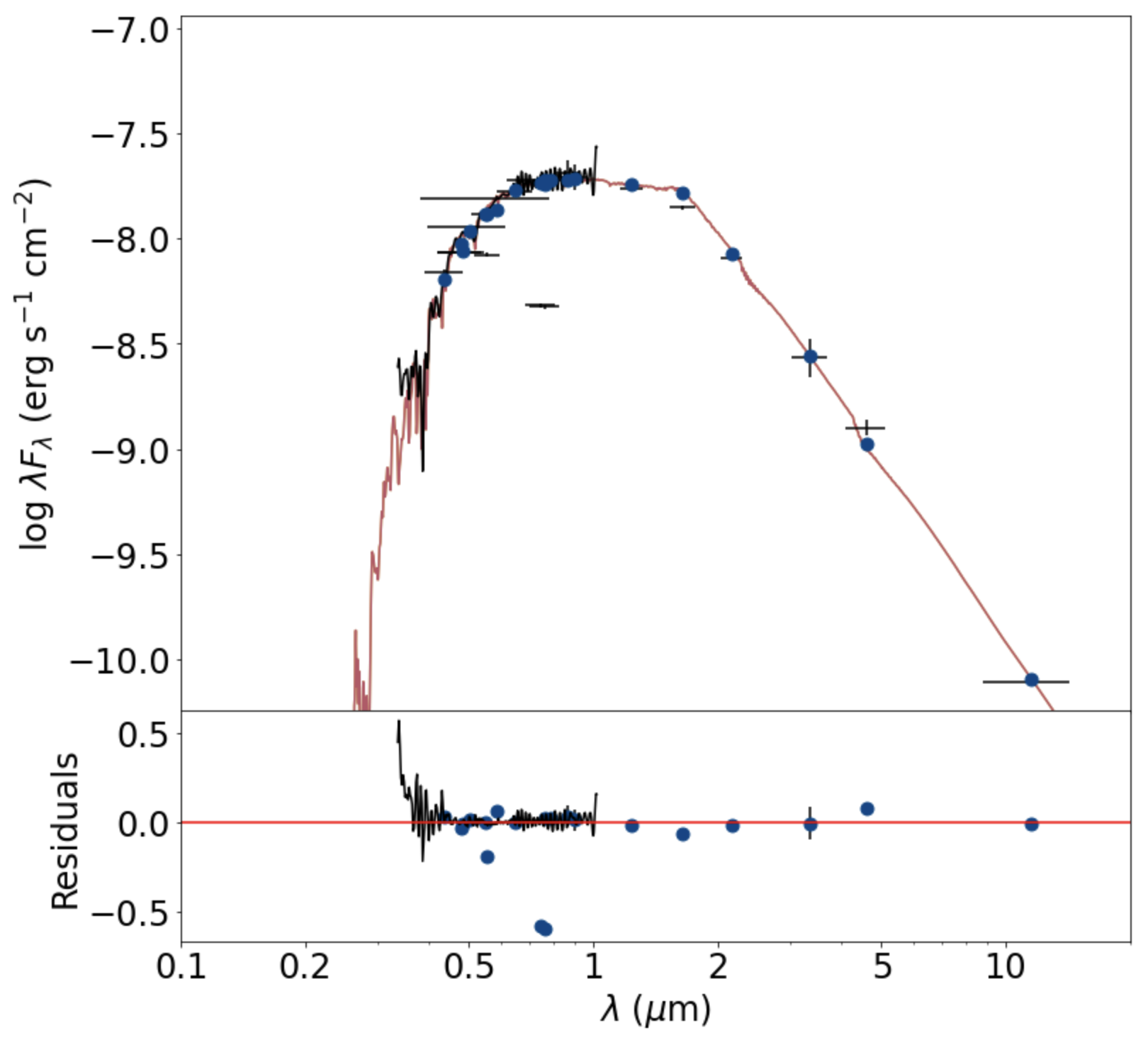
x.makeplot()
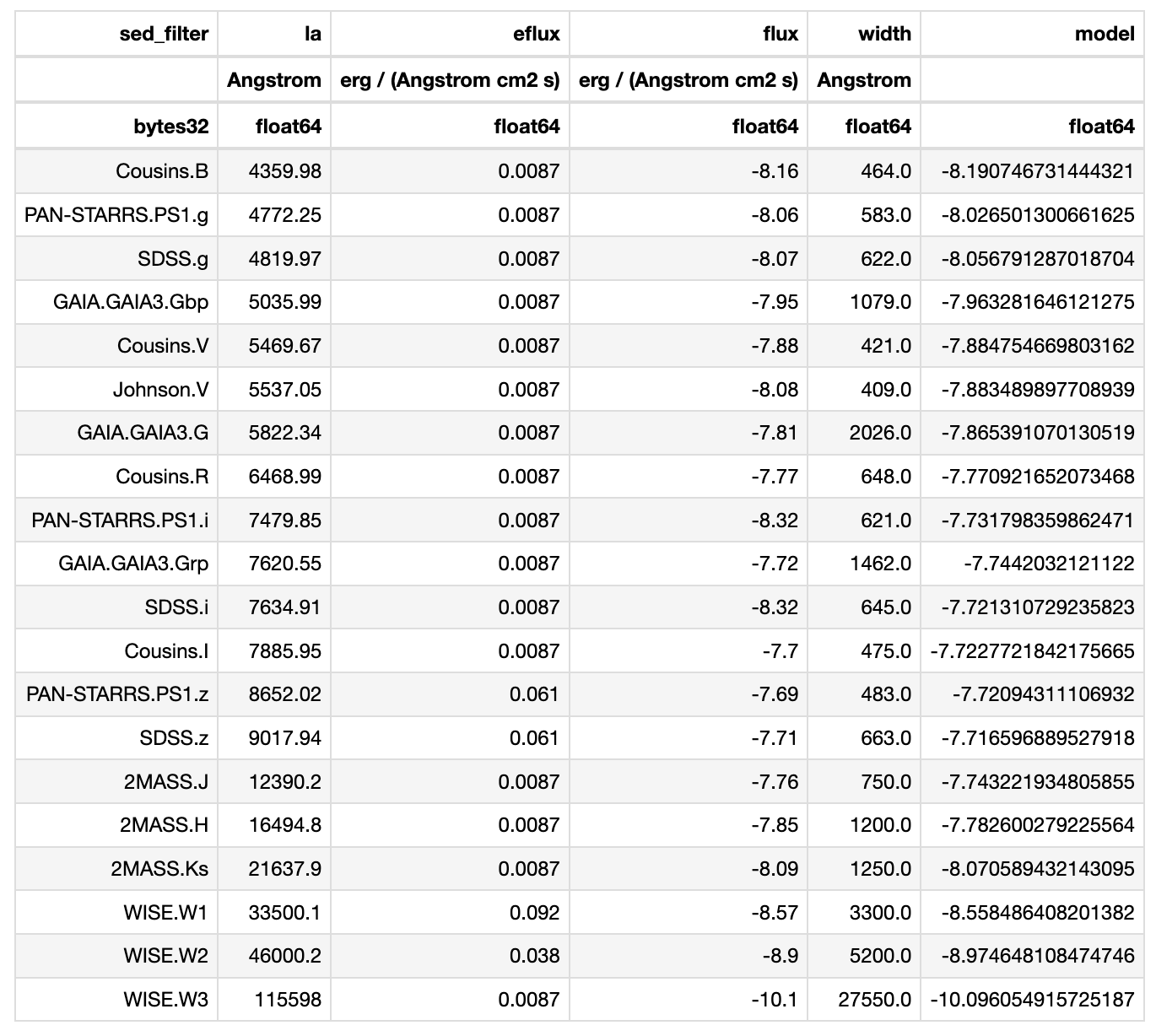
x.sed['model']=x.mags
x.sed
Outputs:
Downloading https://vizier.cds.unistra.fr/viz-bin/sed?-c=30.94630899910999%2035.591296028520006&-c.rs=1 [Done]
INFO: Query finished. [astroquery.utils.tap.core]
Gaia XP spectra available
Gaia DR3 distance towards this source is 196.3 pc
3 sigma uncertainty in distance is 193.1 - 199.6 pc
RUWE is 1.325
Maximum Av along the line of sight is 0.266

Distance: 196.99490190792739 pc
AV: 0.2656945911988027 mag
Radius: [10.615533229632316] Rsun
Teff: [4480.1448640879335] K
Log g: [3.4766722496380282]
Fe/H: -1.2821551967971647
Chi squared: 31.376487311702817
Example usage (binary):
from SEDFit.sed import SEDFit
import matplotlib.pyplot as plt
x=SEDFit('16 21 26.43','21 36 59.0',1,panstarrs=False,grid_type='btsettl')
x.addguesses(dist=600,av=0.,r=[2,2],teff=[4020,6150],logg=3)
x.addrange(dist=[500,3000],r=[1.,5],logg=[3,4],feh=[-0.5,0.5])
idx=range(1,len(x.sed))
pars=x.fit(use_gaia=True,use_mag=idx)
print("Distance: {} pc".format(x.getdist()))
print("AV: {} mag".format(x.getav()))
print("Radius: {} Rsun".format(x.getr()))
print("Teff: {} K".format(x.getteff()))
print("Log g: {} ".format(x.getlogg()))
print("Fe/H: {}".format(x.getfeh()))
print("Chi squared: {}".format(x.getchisq()))
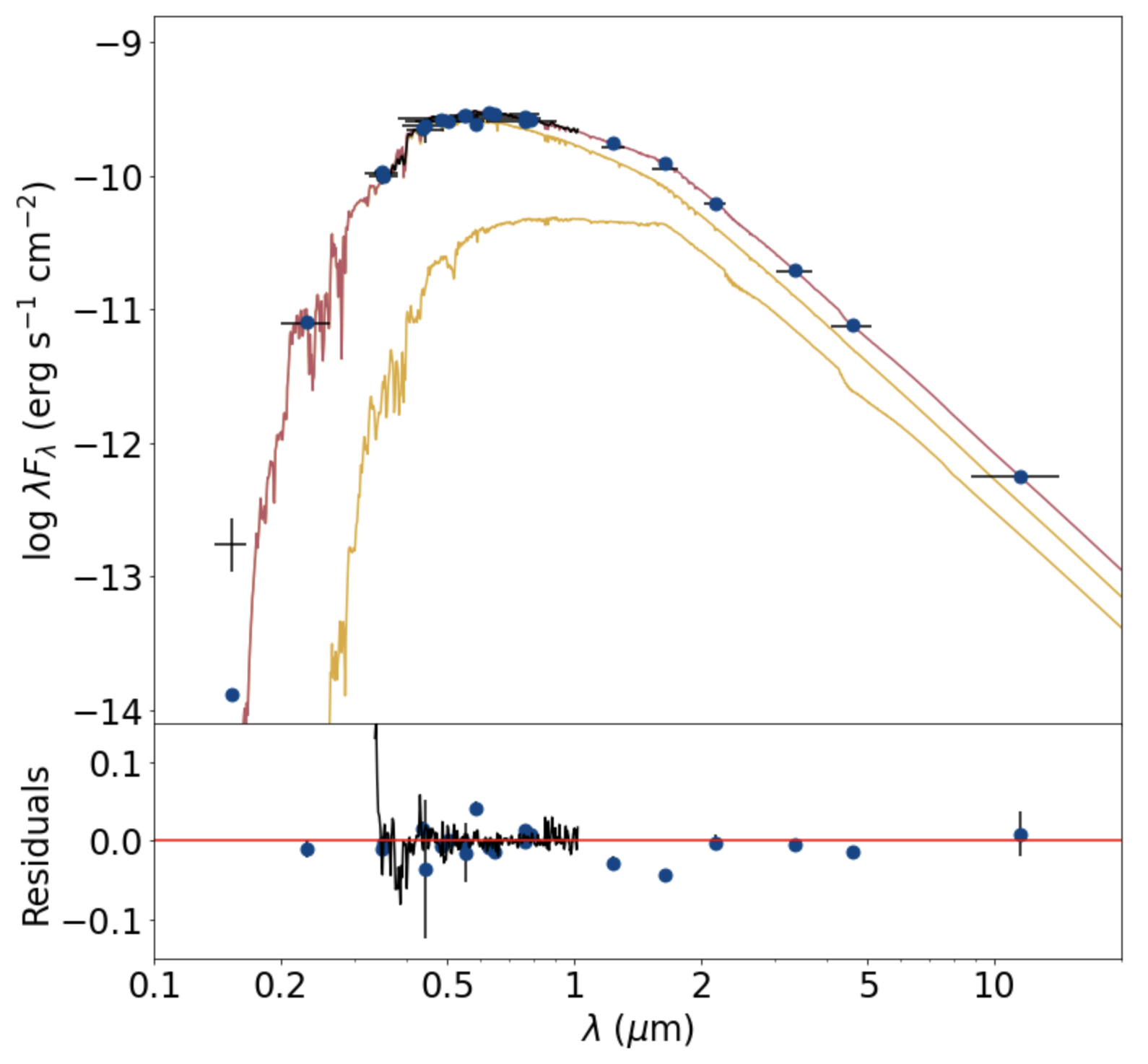
ax=x.makeplot(getplot=True)
ax[1].set_ylim(-0.15,0.15)
plt.show()
Outputs:
Gaia DR3 distance towards this source is 1335.9 pc
3 sigma uncertainty in distance is 945.2 - 2277.2 pc
RUWE is 6.482, distance measurement may be unreliable, proceed with caution
Maximum Av along the line of sight is 0.153

Distance: 667.310459460973 pc
AV: 0.15289027898262858 mag
Radius: [1.7572491971793733, 2.0280969332892815] Rsun
Teff: [4200.000117831155, 6223.8415553868745] K
Log g: [3.0000001515136687, 3.6338373735244778]
Fe/H: -0.008349217988918434
Chi squared: 2.1674361649054195
Detailed description
x=SEDFit(ra,dec,radius=radius,**kwargs)
Initializes SED fitting
Recommended keywords:
- ra: Right Ascention of the target, can be in decimal or hexadecimal format, float or a string.
- dec: Declination of the target, can be in decimal or hexadecimal format, float or a string.
- radius: Radius in arcseconds around which to search Vizier for photometry. (default=1 arcsec)
If coordinates are not provided, initializes a generic star to compute model photometry.
Optional keywords:
- grid_type: Which theoretical SEDs should be used for fitting. Options: 'btsettl' (default, Allard et al. 2011), 'kurucz' (Kurucz 1992), 'coelho' (Coelho 2014), 'phoenix' (Husser et al. 2013)
- frame: reference frame for the coordinates (ICRS by default)
- write: whether to save a fits file containing photometry after querying (default True)
- filename: FITS filename where photometry ang Gaia metadata is/should be saved, uses coordinates as default, string
- use_gaia_params: Whether Gaia astrometry should be downloaded to estimate distances, true by default, boolean
- use_gaia_xp: Whether Gaia XP spectrum should be used or not, true by default, boolean
- download_flux: Whether flux should be (re-)downloaded. False by default if flux_filename file already exists, boolean
- download_gaia: Whether Gaia XP spectrum should be (re-)downloaded. False by default if gaia_filename file already exists, boolean
- parallax_sigma: Range of distances that should be used in fitting based on Gaia parallax and corresponding uncertainty, default is 3 sigma.
- nstar: How many stars to initialize, default is 1.
- maxav: Specify maximum av along the line of sight, will query Fitzpatrick (1999) map by default.
- gaia: Whether Gaia fluxes (G, BP, RP) should be downloaded, True by default, boolean
- sdss: Whether SDSS fluxes (u,g,r,i,z) should be downloaded, True by default, boolean
- panstarrs: Whether PanSTARRS fluxes (g,r,i,z,y) should be downloaded, True by default, boolean
- johnson: Whether Johnson fluxes (U,B,V,R,I) should be downloaded, True by default, boolean
- cousins: Whether Cousins fluxes (U,B,V,R,I) should be downloaded, True by default, boolean
- tmass: Whether WISE fluxes (W1, W2, W3, W4) should be downloaded, True by default, boolean
- galex: Whether GALEX fluxes (FUV, NUV) should be downloaded, True by default, boolean
- wise: Whether WISE fluxes (W1, W2, W3) should be downloaded, True by default, boolean
- spitzer: Whether Spitzer fluxes (3.6, 4.5, 5.8, 8.0, 24 micron) should be downloaded, True by default, boolean
- xmm: Whether XMM fluxes (V, B, U, UVW1, UVM2, UVW2) should be downloaded, False by default, boolean
- vizier_filename: filename to a vot table contianing Vizier photometry queried from http://vizier.cds.unistra.fr/vizier/sed/ (will query based on coordinates authomatically if not specified, only for advanced uses)
- deletevot: if vizier_filename is provided, whether the vot file should be deleted afterwards, True by default, boolean
- checkpos: whether to require all photometry for a given instrument to come from the same catalog, to minimize mistaken identification of sources in crowded regions, False by default, boolean
x.addguesses()
Provides initial guesses to the fitting process
Optional keywords:
- dist: Estimated distance to the system in parsec, Gaia parallax estimate by default, 1000 pc when not available
- av: Estimated extinction to the system in mag, 0 mag by default
- r: Estimated radii of all of the stars in Rsun, stored as list for all of the stars in the system, [1] Rsun by default
- teff: Estimated Teff of all of the stars in K, stored as list for all of the stars in the system, [5000] K by default
- logg: Estimated log g of all of the stars, stored as list for all of the stars in the system, [4] dex by default
- feh: Estimated Fe/H of the system, 0 dex by default
- alpha: Estimated alpha/H of the system, 0 dex by default
- area: Whether surface area is given instead of radius in r, False by default, boolean
Stipulations:
- Lists for all of the variables should match each other in length.
- If there are multiple stars, but only one supplied value, for, e.g., teff, it is assumed that both stars will be initialized with the same teff
- At least one of the lists needs to explicitly have the length of the desired number of elements
- Nested lists are allowed (e.g., if the arrays of areas, teff, logg are produced by the PHOEBE mesh, they can go inside the list as one of the elements, e.g, r=[[meshes for star 1], [meshes for star2], radius3]). In this case, r is treated as the surface area for the stars where mesh is provided.
- Sources where meshes are provided should be passed as is, without additional fitting.
- Initial guesses for teff, logg, feh, and alpha need to be within the bounds of the grid of synthetic SEDs, otherwise it would not be able to function. Refer to the papers of the included models for description.
x.addrange()
Provides the allowed range of values that can be returned by the fitting, specifying lower and upper bound
Optional parameters
- dist: Range of distances in pc, default 3 sigma Gaia parallax estimate, [0, 1e5] when not available
- av: Range of AVs in mag, default [0., maxav.], where maxav is the maximum extinction along the line of sight from Fitzpatrick (1999) map, or the valua that was suplied in the initialization
- r: Range of radii in Rsun, default [0,2000.]
- teff: Range of Teff in K, default [0, 1e6]
- logg: Range of log g, default [-2,10]
- feh: Range of Fe/H, default [-5.,2.]
Stipulations:
- Alpha is included as is, cannot be changed in the model in the fitting process, thus no range for it is provided
- If fitting multiple stars, lists should be nested, e.g, r=[[1,5],[3,4]], this will set the allowed range of radii to be 1-5 Rsun for the first star, and 3-4 Rsun for the second star
- The number of elements for the nested lists should be consistent with the number of stars provided in the addguess() function
- If fitting multiple stars, but providing only two numbers, e.g., r=[1,5], then this range is assumed as valid for all stars
- The ranges can be arbitrary, but keep in mind the bounds of the grid that is being used
x.fit()
Performs the full SED fitting, including r, teff, logg, dist, av, feh
Optional parameters
- full: if True, performs a full fit that includes autonomous determination of teff, logg, and feh. Otherwise stellar parameters are passed as-is from the initial guesses, only radii, distance, and av are fitted. True by default.
- fitteff: if True, includes teff in fitting, otherwise it is passed as is from the initial guesses, True by default
- fitlogg: if True, includes logg in fitting, otherwise it is passed as is from the initial guesses, True by default
- fitfeh: if True, includes feh in fitting, otherwise it is passed as is from the initial guesses, True by default
- fitdist: if True, includes distance in fitting, otherwise it is passed as is from the initial guesses, True by default
- fitav: if True, includes av in fitting, otherwise it is passed as is from the initial guesses, True by default
- fitstar: list of stars that should be used in the fitted process, vs those the parameters of which should be passed directly from the initial guesses unaltered. 1=include, 0=exclude, e.g., [0,0,1] would preserve the parameters of the first two stars and would try to fit the residual fluxes using only the third one. System-wide parameters such as feh, av, dist would be fit in all cases. By default, fits all stars. If meshes are used, fitstar for the stars where this is the case must be set to 0.
- use_gaia: whether to use Gaia XP spectrum in the fitting process, True by default, boolean
- idx: list of indices of x.sed table that are used for fitting, as some fluxes could be of poor quality, such as due to saturation, source mismatch, or IR/UV excess. Uses all fluxes by default. E.g, in the example above, Fluxes from SDSS and Pan-STARRS i band are highly discrepant from the model. To improve the quality of the fit and to exclude them,
idx=np.where((x.sed['sed_filter']!='PAN-STARRS.PS1.i') & (x.sed['sed_filter']!='SDSS.i'))[0] - teffratio: If temperature ratio between secondary and primary is known, it can be specified to constrain the fit.
- teffratio1: If temperature ratio between tertiary and primary is known, it can be specified to constrain the fit (alternatively, a spot contrast ratio for the primary)
- teffratio2: If temperature ratio between fourth star and secondary is known, it can be specified to constrain the fit (alternatively, a spot contrast ratio for the secondary)
- teffratio_error: Weight placed on teffratio in fitting the SED, 0.01 by default.
- radiusratio: If ratio of radii between secondary and primary is known, it can be specified to constrain the fit, float.
- radiusratio_error: Weight placed on radiusratio in fitting the SED, 0.1 by default.
- radiussum: If sum of radii of primary and secondary is known, it can be specified to constrain the fit, float.
- radiussum_error: Weight placed on radiussum in fitting the SED, 0.1 by default.
- fluxratio: If ratio of fluxes at a given wavelength between secondary and primary is known, it can be specified to constrain the fit, float.
- fluxratiolambda: Wavelength at which the flux ratio is determined, required for parsing fluxratio. Quantity, units of wavelength need to be specified.
- fluxratioratio_error: Weight placed on fluxratio in fitting the SED, 0.1 by default.
x.makeplot()
Produces a plot of the SED fit.
Optional parameters
- idx: list of indices of fluxes that should be included inthe plot
- file: string containing a filename (including the extension) to a file where the figure should be saved.
- getplot: whether to return the editable matplotlib ax variable instead of displaying it. False by default.If True,
ax=x.makeplot(getplot=False)
....
plt.show()
x.getchisq()
Calculates Chi squared of the fit.
Optional parameters
- idx: list of indices of fluxes that should be used in the chisq calculation
- gaia: whether to use Gaia XP spectrum in chisq calculation, boolean.
x.getdist(),x.getav(),x.getr(),x.getteff(),x.getlogg(),x.getfeh()
Returns fitted variables. Same as
x.dist, x.av, x.r, x.teff, x.logg, x.feh
Other usefulf variables:
- x.sed: table consisting of the downloaded fluxes from Vizier
- x.gaia: table consisting of the Gaia XP spectrum
- x.mags: array of the model-predicted fluxes for all of the elements in the x.sed table
- x.spec: array of the model-predicted fluxes for all of the elements in the x.gaia table
- x.la: array of wavelength for the model
- x.flux: nested array of the raw fluxes for all of the stars provided by the model (i.e., not scaled by distance, radius, av, etc)
- x.fx: nested array of the fitted model fluxes for all of the stars
- x.f: array of the co-added fluxes for all of the model fitted fluxes
- x.grid_table: list of the spectral parameters for the available synthetic models; if inputs are outside of their range, a blackbody is used instead