##☁️ Cloud-ready | 📱 iPad-compatible
version 1.3.7 | 18 March 2026
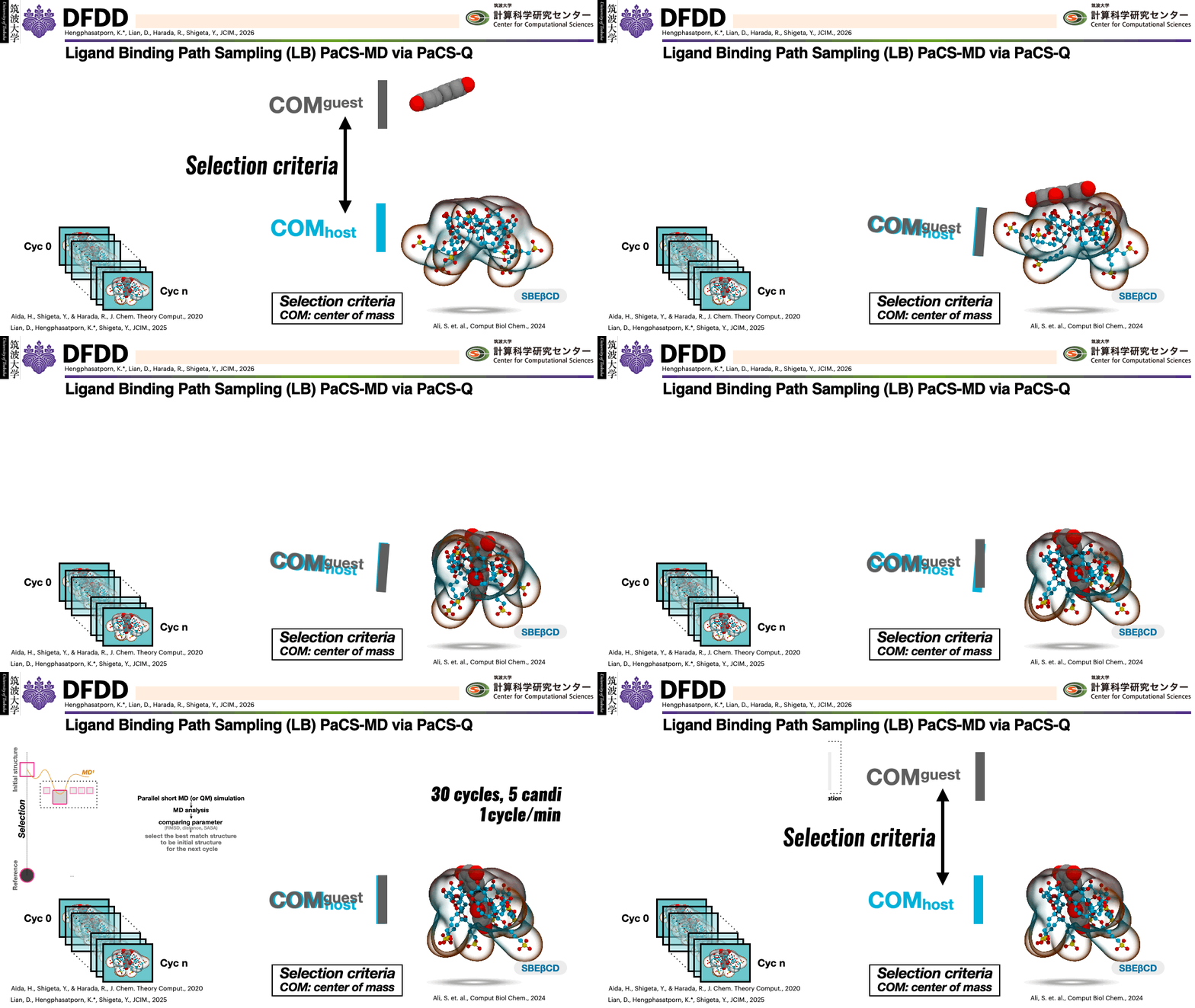





This notebook provides a cloud-friendly workflow for fully dynamic host–guest docking using OpenMM and the LB-PaCS-MD (Ligand Binding Path Sampling based on Parallel Cascade Selection MD) strategy.
It enables students and researchers to explore spontaneous binding and unbinding processes in explicit solvent using enhanced molecular dynamics on Google Colab, with minimal setup.
This notebook accompanies the paper
“DFDD: A Cloud-Ready Tool for Distance-Guided Fully Dynamic Docking in Host–Guest Complexation”
(Journal of Chemical Information and Modeling, 2026)
https://doi.org/10.1021/acs.jcim.5c02852
Rather than relying on static docking poses, DFDD captures natural binding pathways, multiple inclusion modes, and realistic association dynamics through unbiased MD sampling.

DFDD adopts a single, robust ligand parameterization pathway optimized for stability and reproducibility in cloud environments.
- Fast and reliable (seconds per ligand)
- Fully compatible with GAFF2
- Applicable to neutral and charged ligands
- No QM dependencies (Colab-safe)
- Widely accepted in biomolecular MD studies
AM1-BCC is recommended for the vast majority of host–guest systems and ensures smooth execution on free Colab resources.
- Input
- SMILES string or structure file (
PDB,MOL2,SDF)
- SMILES string or structure file (
- Optional pH handling
- pKa prediction and microspecies selection
- 3D structure generation
- RDKit (ETKDG + UFF minimization)
- Charge assignment
- AM1-BCC via AmberTools (
antechamber -c bcc)
- AM1-BCC via AmberTools (
- Force-field completion
- GAFF2 atom typing +
parmchk2
- GAFF2 atom typing +
- Validation
- Charge and topology consistency checks
For rapid ligand preparation and protonation handling, see:
👉 pKaNET_Cloud (Streamlit): https://pkanetcloud.streamlit.app/
- LB-PaCS-MD sampling for unbiased binding pathway exploration
- Explicit solvent MD (TIP3P water + neutralizing ions)
- GPU acceleration via OpenMM on Google Colab
- Ensemble binding modes, not limited to a single pose
DFDD supports a broad range of cyclodextrin hosts with automatic detection and setup:
- Native β-CD
- GLYCAM-06 force field (BCD)
- DFT-derived parameters (default)
- Dimethylated β-CD (DMBCD)
- Methylated β-CD (MBCD)
- Hydroxypropyl β-CD (6-Tetra-hydroxypropyl β-CD)
All hosts are prepared automatically with correct bonding, ring closure, and force-field assignments.
- pH-adjusted ligand structure (optional)
- GAFF2 parameter files (
.prep,.frcmod) - Complex topology/coordinates (
.prmtop,.inpcrd) - MD trajectories (NetCDF)
- Binding mode structures (PDB)
- Free-energy / distance landscape analysis
- MM-PBSA / MM-GBSA binding energy estimates
- DBFE absolute binding free energy (ΔG_bind with T/R entropy correction)
- Downloadable ZIP result bundle
DFDD provides three complementary binding energy estimates, all from the same MD frames:
| Method | Entropy | Solvent | Best for |
|---|---|---|---|
| MM-GBSA | ✗ | GB implicit | Relative ranking |
| MM-PBSA | ✗ | PB implicit | Relative ranking |
| DBFE | ✅ ΔG_TR | OBC2 implicit | Absolute ΔG_bind |
DBFE (Direct Binding Free Energy) computes the full thermodynamic cycle:
ΔG_bind = ΔG_inter + ΔG_TR − ΔG_sym
where ΔG_TR is the translational + rotational entropy correction absent in MM-PBSA/GBSA.
No additional simulations required — DBFE reuses the existing cMD frames.
- Ligand preparation: 30–60 s
- Equilibration: 10–20 min
- One LB-PaCS-MD cycle: 15–30 min
- Full run (3–5 cycles): ~1.5–3 h
- Click Open in Colab
- Select the cyclodextrin host
- Provide the guest molecule (SMILES)
- Run the notebook cells sequentially
- Analyze binding pathways and free-energy landscapes
No local installation or coding experience required.
If you are interested in performing docking using AutoDock Vina v1.2.7 for protein–ligand or cyclodextrin–guest systems, you may also find the following repository useful:
https://github.com/nyelidl/Docking_workshop
If you use DFDD, pKaNET Cloud, or DBFE in your research, please cite:
Hengphasatporn, K.; Duan, L.; Harada, R.; Shigeta, Y.
DFDD: A Cloud-Ready Tool for Distance-Guided Fully Dynamic Docking in Host–Guest Complexation.
Journal of Chemical Information and Modeling, 2026.
DOI: https://doi.org/10.1021/acs.jcim.5c02852
For DBFE:
Binding Free Energies without Alchemy.
arxiv: https://arxiv.org/abs/2603.12253 | Code: https://github.com/molecularmodelinglab/dbfe