An autonomous paid‑ad experimentation agent for startups.
A founder gives HookLoop a product, a budget, and a target cost‑per‑acquisition. Three AI agents then run the growth loop on their own: they form creative hypotheses, generate short‑form ad reels, simulate a campaign, explain what worked and why, and generate an improved batch from what they learned — week after week, with CPC visibly dropping each loop.
HookLoop is not an AI reel generator. It's a self‑improving growth‑engineering agent that happens to generate reels as one step in its loop. The loop is the point.
Watch the demo: https://www.youtube.com/watch?v=RyWogQuJ2y4
- Input — product, budget, past creative, and a target CAC (CAC is primary; cheap clicks are a trap).
- Strategist agent — reads the brief and forms testable hypotheses, each isolating one creative‑DNA dimension (hook, voice, pacing, …).
- Generator agent — turns the hypotheses into 3 ad reels per week, each tagged with structured DNA, and produces a real video for each (Sora).
- Simulator — runs a heuristic 7‑day campaign. A Thompson‑sampling bandit reallocates budget toward what converts and kills what doesn't (gated on a CVR floor, not CPC).
- Analyst agent — declares winners/losers, renders a verdict on each hypothesis, attributes performance to specific DNA values, and writes the brief for next week.
- Repeat — click Run Next Week; the next batch builds on the prior week's winner. Reels evolve and CPC trends down across 3 weeks.
Every panel is driven by Convex reactive queries — the dashboard streams live as the simulation runs, no refresh.
- Frontend — Next.js 14 (App Router), TypeScript (strict), Tailwind, Recharts, lucide-react
- Backend — Convex (database + actions + scheduled functions)
- AI — OpenAI (GPT‑class structured outputs for the agents; Sora 2 for video reels)
Prerequisites: Node 18+, a Convex account, an OpenAI API key (with Sora access if you want live video).
npm install
npx convex dev      # first run provisions a dev deployment + writes CONVEX vars
Set your environment in .env.local:
OPENAI_API_KEY=sk-...                 # used by the agents AND Sora (server-side)
CONVEX_DEPLOYMENT=...                 # written by `npx convex dev`
NEXT_PUBLIC_CONVEX_URL=https://...    # written by `npx convex dev`
NEXT_PUBLIC_CONVEX_SITE_URL=https://...
Then, in a second terminal:
npm run devOpen http://localhost:3000, click Start Experiment → Prefill with Coca‑Cola sample → submit, and watch the loop run.
The
OPENAI_API_KEYis read inside Convex actions, so it must be present in the Convex deployment env (local dev reads.env.local; production needs it set on the prod deployment — see below).
The bundled Coca‑Cola sample is the showcase run:
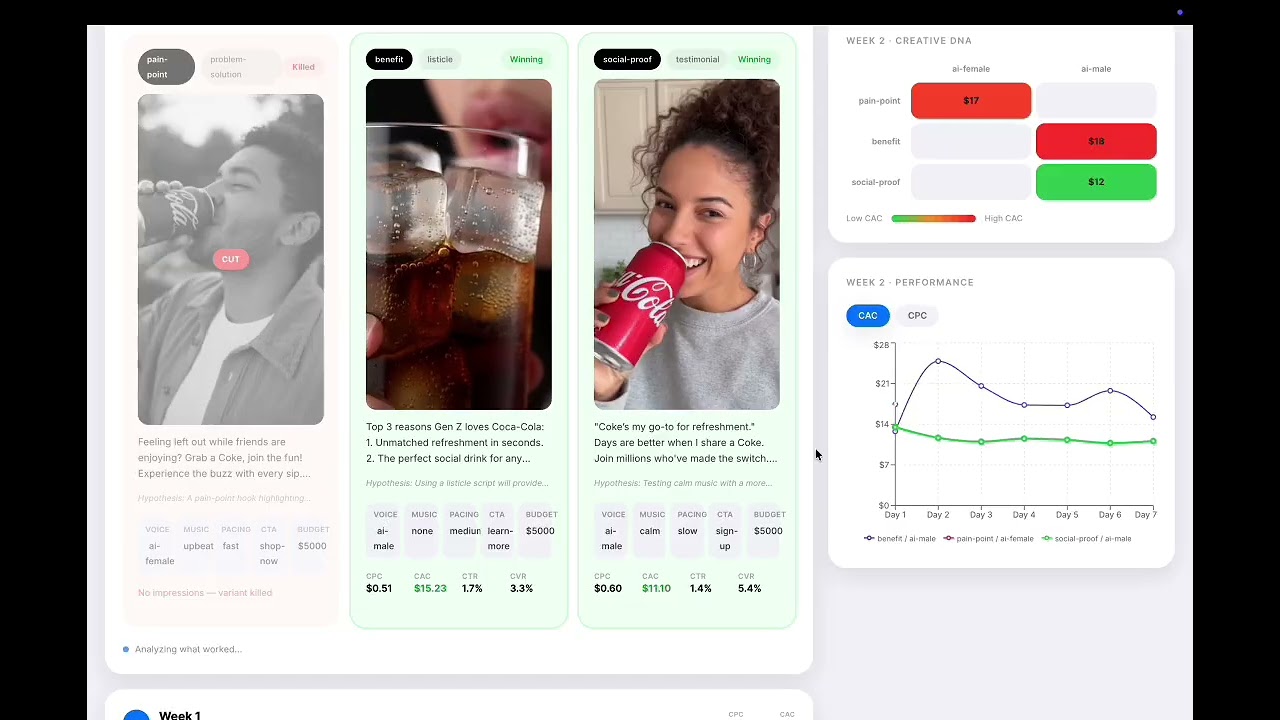
- Weeks 1 → 3 each generate 3 distinct reels. The dashboard stacks one section per week (newest on top); past weeks stay frozen — they aren't re‑analyzed.
- Coca‑Cola serves pre‑generated cached reels from
public/reels/week{w}_slot{n}.mp4(fast, deterministic, no live Sora during the demo). Any other product generates live via Sora. - Killed reels stay visible, dimmed with a CUT badge. Click any reel to play it full‑size with audio.
- Each week ends with a Weekly Report: hypothesis verdicts, what won / was cut, CPC/CAC delta vs last week, and the directive for next week.
The 9 cached reels are generated from feedback‑driven prompts that evolve week over week:
node scripts/generate-cached-reels.mjs # reads OPENAI_API_KEY from .env.local; needs Sora access + creditsFiles land in public/reels/ (existing files are skipped — delete to regenerate).
The backend (convex/) deploys to Convex Cloud; the Next.js frontend deploys to Vercel.
- Backend + URL in one step — in Vercel, set the Build Command to:
and add
npx convex deploy --cmd 'npm run build'CONVEX_DEPLOY_KEY(a Production deploy key from the Convex dashboard) to Vercel's env. This deploys your Convex functions and injectsNEXT_PUBLIC_CONVEX_URLinto the build. - Backend secret — set the OpenAI key on the production Convex deployment (separate from Vercel):
Without it, the agents and live Sora fail in production (Coca‑Cola still works off the cached reels).
npx convex env set OPENAI_API_KEY "sk-..." --prod
VIDEO_ENABLED in convex/video.ts is the kill switch for live Sora if credits run low.
app/                     # Next.js routes (landing, setup, launch, dashboard)
components/              # UI — WeekSection, VariantCard, ReelModal, WeeklyReport, charts
convex/                 # backend: agents, simulator, experiments, video, schema
lib/agents/             # agent prompts + structured-output schemas
lib/simulator/          # pure heuristic campaign simulator + DNA weights
lib/video/              # Sora provider + feedback-driven prompt builder
public/reels/           # cached Coca-Cola reels (week{w}_slot{n}.mp4)
scripts/                # one-off cached-reel generation
- CAC is primary, CPC is secondary. The bandit is gated on a CVR floor so it never learns to buy cheap, non‑converting clicks.
- Three agents, not six — Strategist, Generator, Analyst.
- The simulator is defensible — documented heuristic priors (including a per‑week improvement prior) plus LLM commentary, not random noise.
- Reactive by design —
useQuerydrives every live panel.